
Buying commercial real estate in Florida is one of the most effective ways to build long-term wealth, generate passive income, and diversify your investment portfolio. But commercial transactions are more complex than residential purchases — involving longer timelines, more extensive due diligence, specialized financing, and unique legal and environmental considerations. This commercial property guide walks you through the entire process, from defining your investment criteria to closing day and beyond, with support from experienced brokers in markets like Tampa Bay, opportunities to reinvest through 1031 exchange strategies, and access to assets including vacant land.
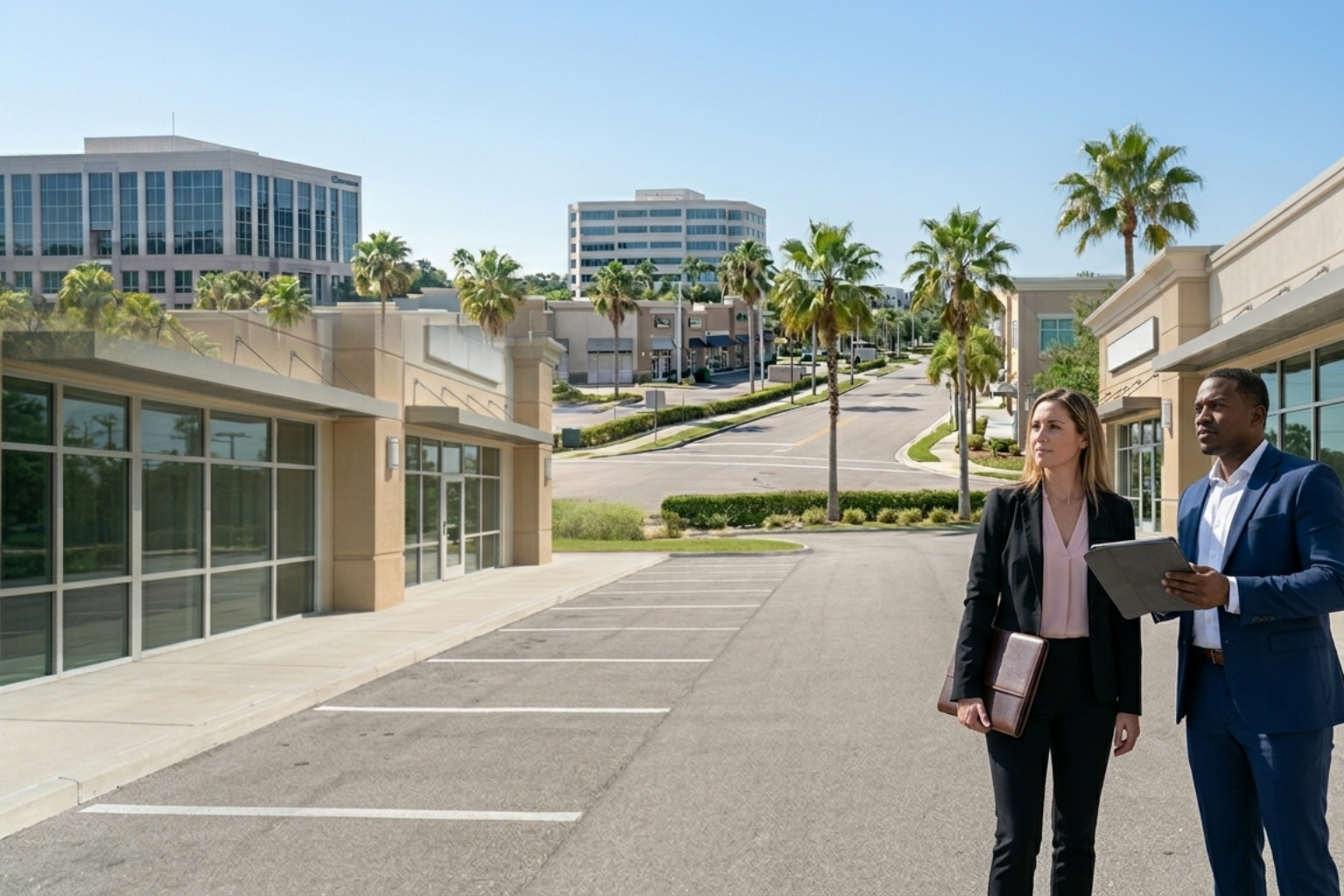
Step 1: Define Your Investment Criteria
Before you look at a single property, you need to know what you’re looking for. The commercial real estate market spans an enormous range of property types, price points, and risk profiles. Clarify the following before you start:
- Property type — Office, retail, industrial, multifamily, mixed-use, or specialty (equestrian, agricultural)?
- Location — Which Florida market? Tampa Bay, Ocala, Lakeland, Okeechobee? Urban, suburban, or rural?
- Budget — What is your total acquisition budget including purchase price, closing costs, and estimated improvements?
- Return targets — What cap rate, cash-on-cash return, or IRR are you targeting?
- Risk tolerance — Are you seeking stabilized, fully leased properties, or are you willing to take on vacancy, renovation, or repositioning risk?
- Timeline — Do you need to deploy capital quickly (perhaps for a 1031 exchange with a 45-day identification deadline) or can you search patiently?
Step 2: Assemble Your Team
Commercial real estate transactions require a team of specialists. Assemble these professionals before you start making offers:
- Commercial real estate broker (Mr. Biggs) — Market knowledge, property sourcing, negotiation, and transaction management.
- Real estate attorney — Contract review, title examination, entity structuring, and closing.
- CPA / tax advisor — Tax implications, entity structure, depreciation strategy, 1031 exchange planning.
- Commercial lender — Financing pre-approval, term negotiation, and appraisal coordination.
- Environmental consultant — Phase I and Phase II environmental assessments.
- Property inspector — Structural, mechanical, and systems evaluation.
Step 3: Property Search & Market Analysis
With your criteria defined and team assembled, the property search begins. Mr. Biggs sources opportunities through multiple channels:
- On-market listings — MLS, LoopNet, CoStar, and commercial listing platforms.
- Off-market opportunities — Mr. Biggs’ network of 27,000+ professional connections generates off-market deal flow that never appears on public platforms.
- Direct outreach — Targeted prospecting to owners of properties matching your criteria.
For every candidate property, Mr. Biggs provides a comparative market analysis including recent comparable sales, current market cap rates, rental rate benchmarks, and a preliminary pro forma projection.
Step 4: Make an Offer & Negotiate
Commercial offers typically start with a Letter of Intent (LOI) — a non-binding document that outlines the proposed purchase price, due diligence period, financing contingency, closing timeline, and key deal terms. Once the LOI is agreed upon, a formal Purchase and Sale Agreement (PSA) is drafted by your attorney.
Key negotiation points include:
- Purchase price and earnest money deposit amount
- Due diligence period length (typically 30–90 days for commercial properties)
- Financing contingency terms
- Seller representations and warranties
- Assignment rights (important for 1031 exchanges and entity structuring)
Step 5: Due Diligence
The due diligence period is where you verify everything about the property. Commercial due diligence is more extensive than residential and typically includes:
- Phase I Environmental Site Assessment — Reviews the property’s environmental history to identify potential contamination. Required by most commercial lenders. Costs $2,000–$5,000 and takes 3–4 weeks.
- Phase II Environmental Assessment — If Phase I identifies potential issues, Phase II involves soil and groundwater testing. Costs $5,000–$20,000+.
- Property survey — ALTA/NSPS survey for commercial properties. Verifies boundaries, easements, encroachments, and setbacks. Costs $3,000–$10,000.
- Title search and title insurance — Verifies ownership history and insures against title defects.
- Zoning verification — Confirms the property’s current zoning allows your intended use.
- Lease audit — For multi-tenant properties, review all existing leases including terms, expiration dates, renewal options, and tenant estoppels.
- Physical inspection — Evaluate structural integrity, roof condition, HVAC, electrical, plumbing, and ADA compliance.
- Financial review — Verify operating statements, tax returns, rent rolls, and expense history for income-producing properties.
Step 6: Financing & Appraisal
Commercial real estate financing differs from residential mortgages in several important ways:
- Down payment — Most commercial loans require 20–30% down. SBA 504 loans can go as low as 10% for owner-occupied properties.
- Loan terms — Commercial loans typically have 5–10 year terms with 20–25 year amortization (creating a balloon payment at maturity).
- Interest rates — Generally 1–3% higher than residential rates, though rates vary based on property type, loan size, and borrower strength.
- Appraisal — Commercial appraisals use income approach (cap rate), sales comparison, and cost approach. They cost $3,000–$10,000 and take 3–6 weeks.
Financing options include conventional bank loans, SBA 504 and 7(a) programs, CMBS loans, bridge loans, hard money loans, and private capital. Mr. Biggs connects buyers with lenders experienced in their specific property type and market.
Step 7: Closing
The closing process for commercial real estate in Florida typically involves:
- Final title review and title insurance issuance
- Loan document execution
- Proration of taxes, insurance, and rental income
- Recording of deed and mortgage
- Disbursement of funds
- Transfer of property management, tenant notifications, and insurance policies
For 1031 exchange buyers, Mr. Biggs ensures that exchange timelines are met and that the qualified intermediary is properly integrated into the closing process.
Tax Strategies for Commercial Buyers
Buying commercial property creates several tax planning opportunities that smart investors take advantage of from day one:
- Cost segregation studies — Reclassify building components for accelerated depreciation, potentially generating $100,000+ in first-year tax deductions on a $1 million property.
- Bonus depreciation — Deduct a percentage of qualifying assets in the year of purchase (20% in 2026 under current law).
- 1031 exchange planning — If you’re selling another property to fund this purchase, a 1031 exchange can defer capital gains taxes entirely.
- Entity structuring — LLCs, land trusts, and other entities provide liability protection and tax flexibility.
Mr. Biggs coordinates all of these strategies through DontPayTax.com, ensuring that your acquisition is optimized from both a real estate and tax perspective.