
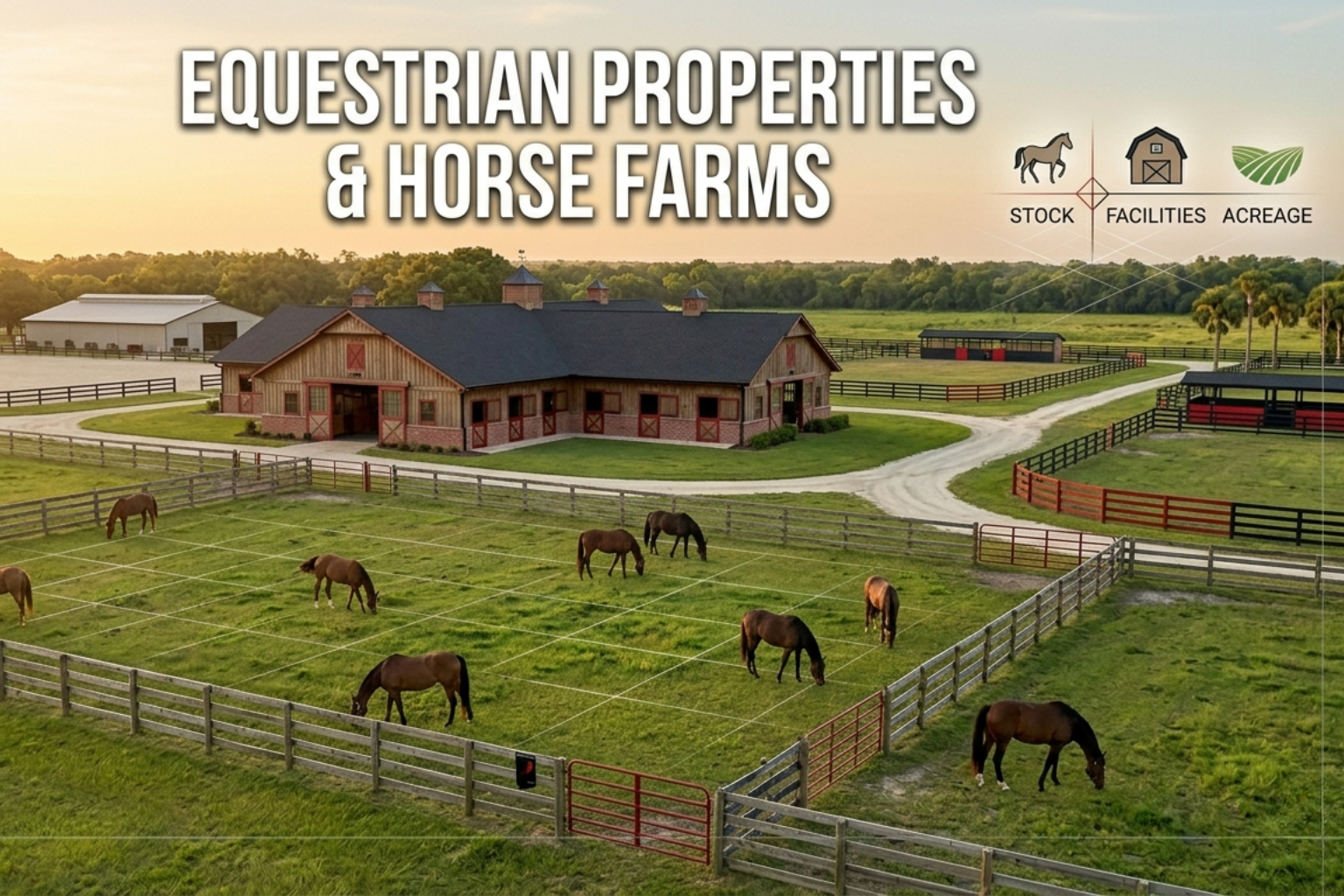
Mr. Biggs is one of Florida’s leading equestrian property brokers, specializing in horse farms, riding estates, training facilities, and equestrian-zoned acreage across Odessa, Ocala, Lutz, and the greater Tampa Bay region. Buying or selling an equestrian property is fundamentally different from a standard residential transaction — it requires a broker who understands barn construction, pasture management, fencing standards, water systems, and the zoning requirements that make a property truly horse-ready. Florida’s climate, tax environment, and proximity to major show circuits make it one of the most desirable equestrian markets in the United States. Whether you’re relocating from the Northeast, upgrading your current facility, or looking for your first horse property, Mr. Biggs has the local expertise to help you find exactly what you need, including guidance on structuring purchases through 1031 exchange strategies and identifying opportunities in related assets such as agricultural land.
Large Acreage Parcels for Equestrian Land Owners
Last updated: April 2026
Why Florida Is a Top Equestrian Market
- Year-round riding weather, No winter downtime means more training days and longer competition seasons.
- No state income tax, Florida’s tax structure is especially attractive for equestrian professionals and high-net-worth horse owners.
- Proximity to show circuits, HITS Ocala, Tampa Bay Downs, the Florida Horse Park, and numerous regional competitions are within easy reach.
- Agricultural tax exemptions, Qualifying horse properties can receive Florida’s Greenbelt agricultural exemption, significantly reducing property taxes.
- Strong equestrian community, From Ocala’s world-class breeding and training operations to Odessa’s family-friendly horse neighborhoods, Florida has infrastructure and community that support every discipline.
Top Florida Markets for Equestrian Properties
Odessa, Tampa Bay’s Equestrian Corridor
Odessa is the premier equestrian community in the Tampa Bay area. Located in northwest Hillsborough County, Odessa offers large-lot zoning that accommodates horses, with many neighborhoods specifically designed for equestrian living. Communities like Keystone Ranch, Country Walk Equestrian, and Twelve Oaks feature riding trails, shared arenas, and horse-friendly covenants. Properties typically range from 2 to 20+ acres with prices from $500,000 to $3 million+ depending on improvements, acreage, and barn quality.
Ocala, Horse Capital of the World
Ocala (Marion County) is the undisputed center of Florida’s equestrian industry. With more than 1,200 horse farms, multiple world-class training and competition facilities, and a centuries-long tradition of thoroughbred breeding, Ocala offers everything from starter farms to multi-million dollar estates. The cost of entry is significantly lower than Tampa Bay — quality equestrian properties start in the $300,000 range, making Ocala attractive for buyers who want more acreage and better facilities per dollar.
Lutz & North Tampa
For buyers who want equestrian capability without leaving the Tampa suburbs, Lutz and north Tampa offer a selection of properties on 2–10 acre parcels with horse-friendly zoning. These properties are ideal for small-scale equestrian operations — one to five horses — where proximity to schools, shopping, and Tampa employment centers is a priority.
Equestrian Market Comparison
| Factor | Odessa | Ocala | Lutz |
|---|---|---|---|
| Avg. Acreage | 5–20 acres | 10–100+ acres | 2–10 acres |
| Price Range | $500K–$3M+ | $300K–$5M+ | $400K–$1.2M |
| Disciplines | All-around, trail, show | Thoroughbred, sport horse, all | Trail, small-scale show |
| Commute to Tampa | 25–40 min | 75–90 min | 15–30 min |
| Ag Tax Exemption | Available | Common | Available on qualifying parcels |
| Show Facilities | Community arenas | World-class (HITS, WEC) | Limited |
What to Look for in an Equestrian Property
Every equestrian property evaluation should address these critical factors:
- Barn construction, Look for adequate stall size (12×12 minimum), ventilation, drainage, tack rooms, wash racks, and hay storage. Steel construction with proper ventilation is standard in Florida.
- Pasture quality, Evaluate grass type (Bahia and Bermuda are common in Florida), drainage, irrigation access, and rotational grazing capability.
- Fencing, Four-board wood, vinyl, or high-tensile wire are standard for equestrian properties. Avoid barbed wire, which is unsafe for horses.
- Water access, Verify well capacity, water quality, and whether the property has sufficient water for horses, irrigation, and potential expansion.
- Zoning, Confirm the property is zoned for horses and that there are no HOA restrictions on equestrian use. Mr. Biggs verifies all zoning before showing properties.
- Arena and riding facilities , Covered or uncovered arena, round pen, and trail access add significant value and functionality.
- Road access and trailer maneuverability, Ensure driveways and roads can accommodate horse trailers and large delivery vehicles.
Equestrian Property Valuation
Equestrian properties are valued differently from standard residential real estate. Standard comparative market analysis (CMA) methods often undervalue equestrian improvements because comparable sales may not exist in the immediate area. Mr. Biggs uses a combination of residential comps, agricultural land comps, and replacement cost analysis for barn and arena improvements to provide accurate valuations that reflect the true market value of equestrian properties.
List Your Property with a Specialized Broker
If you own an equestrian property, horse farm, or horse-ready acreage in Florida, we help you position, price, and market your property to qualified buyers. From private riding estates to professional training facilities, our approach focuses on maximizing value while identifying opportunities for tax advantages, including 1031 exchanges where applicable.
Selling Your Equestrian Property
Selling a horse property requires marketing to a specialized buyer pool. General MLS listings often fail to reach serious equestrian buyers because they don’t highlight the features that matter — stall count, pasture acreage, arena dimensions, and discipline suitability. Mr. Biggs markets equestrian properties through equestrian-specific channels, professional networks, and targeted outreach to qualified buyers.
If you’re selling an equestrian property and want to defer capital gains taxes, Mr. Biggs can coordinate a 1031 exchange through DontPayTax.com, allowing you to reinvest into another property without triggering a tax bill.